When I was first told that Einstein’s theory of special relativity explains how the magnetic field around a wire works, I was blown away. How can something we learn in physics class, which we assume has no usage in real life, explain something so useful and arguably one of the fundamental to modern society ?
Let’s explore special relativity first and cover the basic concepts needed to understand the connection between these two.
Special relativity tells us that the speed of light is constant for all observers, regardless of their motion. This universal speed limit gives rise to a phenomenon called length contraction. Distances physically shrink in the direction of your motion. This means if you are moving fast along the x-axis, the distance between objects ahead of you will shrink from your perspective, but their height (along the y-axis) remains exactly the same! For example, if you are traveling close to the speed of light on a road with signs placed exactly every 1 kilometer, the distance between those signs would appear to be much less than 1 kilometer to you, yet the signs themselves would still be their normal height.
Now, with this in your minds, I encourage you to look at the picture below:
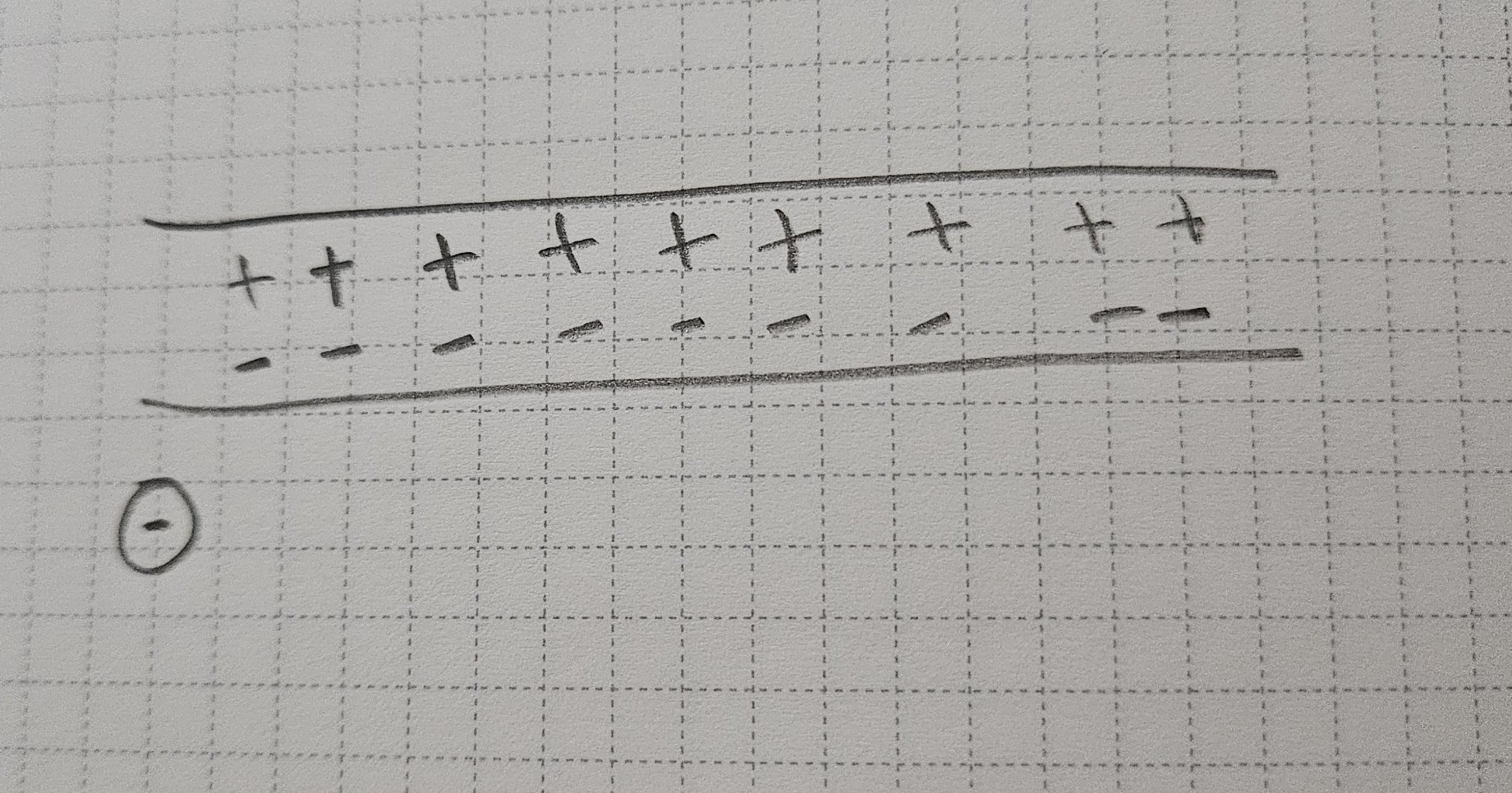
In this picture, we have a neutral wire and a single negative charge just outside of it, just hanging around. Imagine a current flowing through the wire, meaning the negative charges (electrons) inside are moving from left to right. At the same time, we move our external negative charge parallel to the wire, in the exact same direction and at the exact same speed.
So, in the eyes/reference-frame of our moving negative charge, the electrons inside the wire appear completely stationary because they are moving together in perfect parallel. But since we are now looking at the universe from the perspective of this moving charge, something else happens due to special relativity: the positive charges in the wire, which were stationary to us in the lab, are now moving backward. Because they are moving, the distance between those positive charges shrinks! (SPECIAL RELETIVITY!).
Now let’s think about it. We have a single negative charge moving in harmony with the electrons in the wire. From its perspective, the positive charges in the wire suddenly look bunched closer together than they did before.
What does our single negative charge actually see? It sees a certain amount of stationary negative charge, but a much higher density of positive charge packed into the same space. Remember, our wire is normally neutral, and we haven’t added or removed any charges. But because the distance between the positive charges has shrunk, the wire is no longer neutral in this reference frame (the reference frame of our single moving negative charge). This is the recipe for a positively charged wire, which naturally attracts our single negative charge (since opposites attract). Now, where is the magnetism in this? It’s only in our minds.
To our human eyes standing in the laboratory, this wire is still perfectly neutral. We aren’t moving with the electrons or anything, so to us, the positive and negative charges balance out completely, the same old neutral wire. Yet, we still physically observe that a single negative charge is being pulled toward the neutral wire. How? We invent a new name for the phenomenon: the “magnetic force.”
In reality, the magnetic force is just the electric force in disguise. It is the exact same fundamental electric interaction, but because we (the stationary observers) see an attraction between a neutral object and a negative charge, we categorize it as something else entirely. And that’s it, it’s all about perspective.
But wait, there’s more.. to be continued…